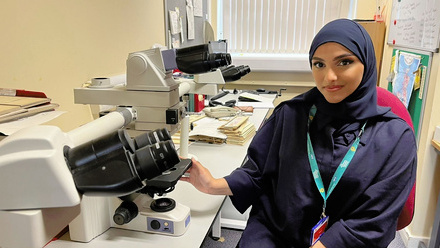
Pathology Summer School 2025: Inspiring the next generation
This year’s Summer School offered students a unique opportunity to immerse themselves in the world of pathology through an exciting 2-day programme held at both the College and the Gordon Museum of Pathology. The schedule featured an engaging mix of lectures, interactive breakout sessions and hands-on activities, giving students a real sense of the specialty’s diversity and its vital role in modern medicine.
Students connected directly with trainees and consultants, gaining first-hand insights into career pathways and the realities of working in pathology. Highlights included small-group discussions, practical sessions and a relaxed BBQ at the College – providing space for networking and informal conversations with experts. To ensure the event remained accessible, overnight accommodation was offered to students travelling from outside London.
Applications for the 2026 Summer School will open early next year. With its growing reputation and consistently positive reviews, the event continues to foster enthusiasm and to inspire future pathologists.
One participant summed up the experience beautifully: “I never knew I could fall in love with a specialty so quickly. Just 2 days at this Summer School made me fall head over heels for one of the most underrated and undervalued fields in medicine. Everyone should have the chance to experience this. I’m incredibly grateful to the College for an unforgettable couple of days – so many new friends, inspiring conversations with experts and a newfound passion for a field I can’t wait to join. Thank you!”
A heartfelt thank-you goes to our generous sponsors, whose continued support makes this event possible: the British Division of the International Academy of Pathology, the Pathological Society, the British Society for Haematology, the Association of Clinical Pathologists, the British Infection Association and the British Neuropathological Society.
The following sections highlight what some of our attendees had to say about the Summer School.
Memorable moments
Attending the RCPath Summer School was genuinely one of the highlights of my summer. I applied mainly out of curiosity. As a medical student, I think it's important to explore a wide range of specialties early on, and I didn’t have much exposure to pathology before this.
There were lots of memorable moments, but the histopathology session with Dr Ghosh really, stood out. It’s a subject that can often feel confusing or overwhelming, but the way he explained it made everything so clear. I still remember the details and, honestly, it was one of the best lectures I’ve attended, including those at medical school.
What surprised me most was just how wide-reaching pathology is. I hadn’t fully appreciated how involved it is in every aspect of medicine, from antenatal screening through to post mortems. It gave me a new perspective on the specialty.
Since the summer school, I’ve been seriously considering doing a student-selected component or elective in pathology, possibly in histopathology or neuropathology. I’d highly recommend the programme to any student wanting to better understand the science that underpins clinical decision-making.
Ebrahim Rezaei
An enthralling and discerning look
Over the course of 2 days at the Pathology Summer School, an enthralling and discerning look at pathology was presented. During the summer school, a variety of guest speakers with extensive backgrounds presented, including the Dean of Medical Education at King's College London, discussing in depth her path to specialty training. Additionally, we attended breakout sessions on different specialties within pathology, such as clinical biochemistry and histopathology. As part of these breakout sessions, participants were given an interactive and detailed introduction to each specialty, with a demonstration in the haematology session using fruit to mimic the process of taking a bone marrow biopsy.
Each medical professional seemed passionate and thoroughly engaged with their sessions, delivering a positive insight into pathology. During the second day of the Summer School, we had the opportunity to visit the Gordon Museum of Pathology. My interest in the field of pathology has been sparked by seeing firsthand the significance and impact of pathology, as well as hearing and witnessing the enthusiasm guest speakers had for their work. Having the chance to network with other like-minded medical students and pathologists has given me a newfound outlook on the specialty, which I believe this Summer School has inclined me towards.
Maryam Aziz
A highly insightful experience
The RCPath Summer School opened with engaging talks about the field of pathology from President Bernie Croal, Nicki Cohen and Peter Johnston. Coming from a biomedical science background, it was inspiring to see how vital pathology is to developing medicine and the intersection of multidisciplinary roles across pathology. Learning how to decipher cases from a wide range of pathology specialties with the help of experienced specialists was a privilege.
Day 2 took place in the Gordon Museum of Pathology, which houses one of the world’s largest pathological specimen collections. The Pots session was fascinating as we identified conditions based on their physical presentation in various organs. Having a long-term interest in infectious disease, I found clinical microbiology particularly exciting. Shabana Allsopp emphasised the importance of thorough history-taking and common causes of nosocomial infections – a rising challenge in the context of multidrug-resistant microorganisms. I was motivated by the broad applications of clinical microbiology, even contributing to translational epidemiological initiatives.
Throughout the Summer School, the core value of community continuously emerged. Pathology specialists both nationally and internationally collaborate to improve collective knowledge, treatment options and patient outcomes. This experience was highly insightful, and I look forward to pursuing a pathology career further!
Aarushi Chakraborty
Pathology is vital
My education in pathology started at the College with talks from the inspiring team, which introduced us to the many pathology specialties. It was fascinating to learn how they work together, using their different expertise to advise patient care. While pathological investigations are often conducted away from the public gaze in laboratories, the work can be overlooked. However, I learnt pathology is vital in advising all sectors of diagnostic and therapeutic healthcare.
Doctors from fields ranging from immunology to paediatric pathology engaged us with quizzes, case studies and practical simulations in workshops. This showed us the value of being a doctor working in clinical and laboratory sectors. This stimulating day ended with a delicious dinner on the College’s terrace, where we consolidated new friendships with peers and discussed pathology with the team.
At the Gordon Museum, I was fascinated to learn about topics including the importance of microbiology in diagnosing perplexing cases and the legal aspects of death investigations. Throughout, we were surrounded by pots filled with preserved pathological specimens affected by many diseases. It was thought-provoking to tour and discuss these pots, completing my introduction to the wonderful world of pathology.
Kareena Cooper
A host of informative lectures
The great thing about extracurricular medical conferences is that you meet people whose passion for their subject is contagious! At last year’s Pathology Summer School, we received a host of informative lectures, including from the President of the Royal College of Pathologists and Professor Nicki Cohen. The lectures demystified the work of the pathologist, clarifying that pathology is less about dead bodies and microscopes and more an evolving, essential part of any multidisciplinary team, where a fundamental understanding of the science of disease is used alongside modern technology to pioneer a cure.
A series of short but punchy workshops in specialist pathology areas presented us with real-life problems, images and test results. In discussion with expert pathologists, we walked through how a diagnosis had been made and treatment adapted. All specialist workshops were fascinating, but my particular favourites were with a neuropathologist, who found a cure for a neonate brain tumour, and a chemical pathologist, who presented the case of a newborn with XY karyotype and clitoromegaly. I’d covered adrenal pathways in med school, but applying my patchy background knowledge to a real-life case bridged the gap between theory and reality, cementing my understanding of adrenal hyperplasia and 21-hydroxylase deficiencies in a way that a medical school lecture never could.
The ability to meet people who enjoy their career was a fabulous reminder that, despite the 5-year slog, a rewarding and privileged career awaits.
Chloe Vaughan
Read next