
An update on cervical cancer screening in Moldova in collaboration with the College
Cervical cancer testing rates in Europe were found to be lower in countries such as the Republic of Moldova (Figure 1).1 Moldova has a total population of about 4 million, of which 1.3 million are women aged 15 years and older who are at risk of developing cervical cancer. Estimates indicate that every year 480 women are diagnosed with cervical cancer and 248 die from the disease.
Figure 1: Proportion of women aged 30–49 years who reported receiving a cervical smear test, by country and year.
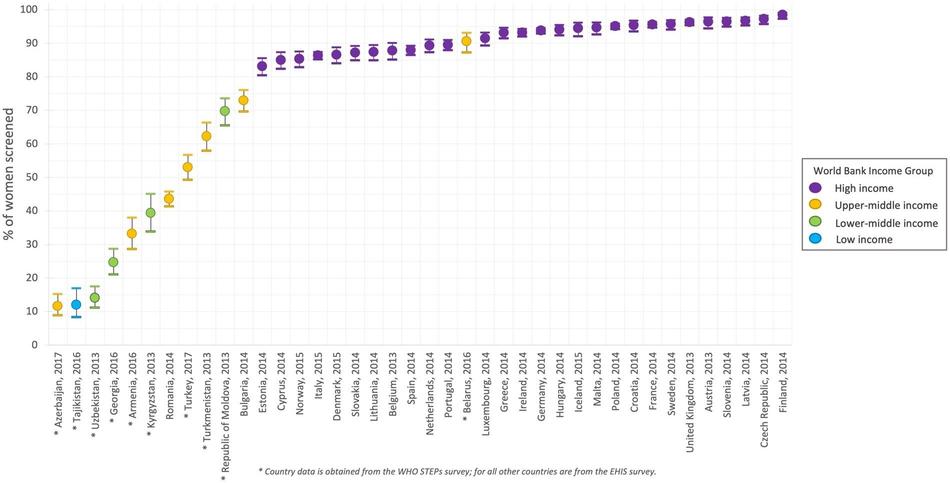
In Moldova, 70% were screened compared with 95% in the UK.1
Working together
The Royal College of Pathologists is 1 of several medical institutions that has played a leading part in supporting the development of the gynaecological pathology service for cervical screening in Moldova. An international collaboration began in 2016 between the College, the International Cervical Cancer Prevention Association (ICCPA) and the British Association for Cytopathology (BAC) to strengthen Moldovan pathology services.
Diana Valuta, Head of the Cervical Cancer Screening Coordination Unit in Moldova, said in 2022: “For 10 years we have been fighting for the health of women in the Republic of Moldova. During this time, we have not been alone in our struggle, we have been supported by many partners. I would like to thank the Ministry of Health of the Republic of Moldova, international organisations, medical institutions, young volunteers and all those who have joined efforts to eliminate cervical cancer. We are different, but we fight for the same cause, to save the lives of our women.”
Increasing awareness
During Moldovan Cervical Cancer Prevention Week, held in January 2022, several public information and awareness actions called on women to take regular prevention cytological tests to maintain their health (see the poster below). The campaign “Stay healthy. Do the Papanicolaou (PAP) test” was one of the actions to raise awareness. A previous survey conducted in 2020 showed that the knowledge of Moldovan women aged 25–61 years about the cytology screening test increased from 47% in 2018 to 62% in 2020, and the number of women tested doubled.
In addition to informing and changing women’s behaviour, important results in the health system have been achieved, such as the establishment of the Cervical Screening Implementation Coordination Unit and the National Reference Centre in Colposcopy. A national colposcopy network was launched in 2023 and uses videoconferencing to view images online. At the same time, medical specialists are being trained by UK histopathologists, and the cytology laboratories have been given updated equipment.

Sharing expertise
Dr Michael Coutts, Consultant Pathologist at Maidstone and Tunbridge Wells NHS Trust, has been working alongside a team of pathology professionals from the UK on supporting all areas of the new cervical screening process, from planning its development to welcoming its first patients. Moldovan colleagues continue to share cases with him to corroborate their findings with his professional opinion.
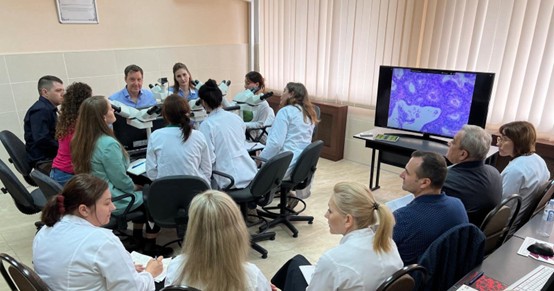
Dr Coutts has delivered workshops and webinars to the majority of Moldovan pathologists working in the state sector (see the image below). Plans are now being developed to welcome more Moldovan pathology colleagues to Maidstone Hospital in Kent to further improve their practice.2
Making progress
Statistical data shows that the number of women in Moldova who have undergone cytology screening has almost doubled in 3 years, increasing from 36% in 2021 to 62% in 2023. Hence, Moldova should achieve at least 1 of the World Health Organization (WHO) cervical cancer elimination targets for 2030, which is that 70% of women are screened with a high-performance test by 35 years of age and again by 45 years of age.3 At the same time, more cases of cervical cancer are being detected early – at the first and second stages.
Another WHO target is that 90% of girls should be vaccinated against human papilloma virus (HPV) infection by age 15 years; so far, 62% have been vaccinated by that age.4
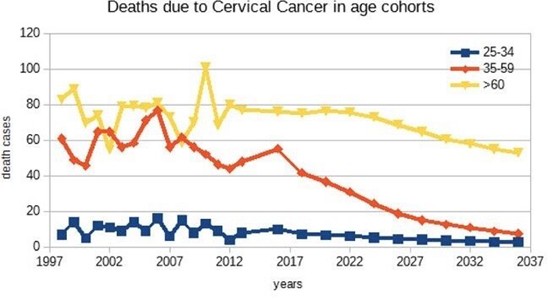
Projected cervical cancer mortality to 2037 based on data from the Institute of Oncology and Statistics Moldova is shown in Figure 2. The screening programme now has the necessary mechanisms to eliminate cervical cancer in the long term; by 2025, a 25% decrease in incidence and a 5% decrease in mortality is expected.
Having been involved in the initial RCPath scoping visit to Moldova’s capital city ChiÈinÄu, it is very satisfying to see this collaborative venture making significant progress. Moldova is on track to achieve 2 WHO cervical cancer elimination targets for 2030 – namely, that 70% of women are screened by age 35 years and 90% of girls receive the HPV vaccine by age 15 years.
References available on our website.
Read next