Last year’s International Pathology Day focused on the topic ‘The impact of climate change on disease and what can be done to tackle the challenges’, with talks, a roundtable discussion and more from a variety of global voices in healthcare, climate and sustainability.
Around 60 participants and 12 event contributors took to their screens from around the world to join us for our virtual conference on Wednesday 8 November 2023. Our special guest keynote speaker, Professor Virginia Murray, joined the event.
This year’s IPD also marked the final time Professor Mike Osborn would open the conference as College President and was the perfect time to introduce and hear from our new President, Dr Bernie Croal.
Our speakers
Professor Virginia Murray
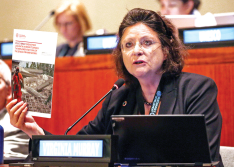
Professor Virginia Murray’s keynote talk titled 'the climate crisis is a health crisis' addressed how there is significant potential to generate and compound complex health security challenges.
Some of these challenges included:
- heat-related mortality increasing in every inhabited continent
- increases in waterborne and vector-borne diseases, as evidenced by increased childhood diarrhoeal disease, which is observed in some regions during extreme weather events
- how climate change undermines health determinants and increases pressures on health systems, threatening to reverse decades of progress to promote human health and wellbeing, particularly in the most vulnerable communities.
These all serve to exacerbate health inequalities.
Dr Jorge Abarca
Dr Jorge Abarca’s talk on climate change and dengue fever comprehensively examined the tangible impact of climate change on the geographical distribution of dengue fever. With a focus on empirical evidence and epidemiological data, he dissected the intricate relationships between climatic variables, vector ecology and dengue transmission dynamics.
Methodological approaches for quantifying and predicting these changes were explored, emphasising the quantitative aspects. Furthermore, he investigated the practical implications for healthcare systems, public health interventions and vector control strategies in regions affected by shifting epidemiology. The discussion centred on evidence-based insights.
Dr Sudha Ranganathan

Dr Sudha Ranganathan focused her talk on climate change and its impact on healthcare in India, its effect on the prevalence of diseases in tropical climates and the resulting challenges for blood transfusion services in India. Furthermore, Dr Ranganathan spoke about how preparedness to tackle the challenges requires planning and implementation by recruiting voluntary blood and platelet donors. This is difficult since every blood component has a specific shelf-life. These components are wasted if more is stored than is needed, but enough stocks must be maintained to support patients when required.
Sheri Scott

Sheri Scott's talk on 'applying sustainability principles in pathology practice' looked at the carbon footprint of a pathology service and discussed what processes and practices can be adapted to reduce this. It explored the barriers to change and areas to target for improvement. Learning outcomes of this talk included understanding the relationship between the climate emergency and public health, considering changes in practice to meet the sustainability agenda and highlighting quick sustainable wins.
The roundtable discussion
The roundtable focused on planetary health and what can be done to encourage evidence-based, environmentally sustainable policies to promote human health, wellbeing and prosperity. It explored food security and nutrition risks, antimicrobial resistance and the challenges posed by climate change for world populations.
The discussion was chaired by Professor Mike Osborn, the College’s President at the time of the virtual conference (now immediate-past President) and he was joined by a team of expert panellists. The panellists included Profess or Sergei Shubin (Director of the Centre for Migration Policy Research at Swansea University), Dr Claire Gordon (Infectious Diseases and Clinical Microbiology Consultant at the UK Health Security Agency), Dr Zoi Pana (Associate Professor, European University of Cyprus, specialised in Epidemiology, Infection Prevention, and Antimicrobial Stewardship at the Johns Hopkins Hospital USA) and Dr Shireen Kassam (Consultant Haematologist and Honorary Senior Lecturer at King’s College Hospital, London).
Lunchtime activities

Daniel Ross, Chief Executive of the College, presented the College’s net zero strategy and carbon reduction roadmap project. This presentation explained more about the College’s strategy to reduce carbon use across our operations, which will eventually lead to achieving net zero.
Winners of the poster competition
The poster competition provided the opportunity for people worldwide to showcase what they have been working on individually or as part of a team. A range of research ideas across all specialties was highly encouraged – from the event’s theme to more general pathology-related work that entrants are proud of and want to spotlight.
Dr Claire Gordon, one of the panel of judges, announced the winners. First place went to a poster titled ‘Deep penetrating naevus case report’. Second place was awarded to the poster titled ‘A pilot study on synchronous and metachronous multiple primary malignancies’, and in third place was ‘Muscle involvement in lymphoplasmacytic lymphoma’.
[[widget:gallery:widget]]View the winning posters, all 8 entries and their accompanying selfie-style videos from our website.
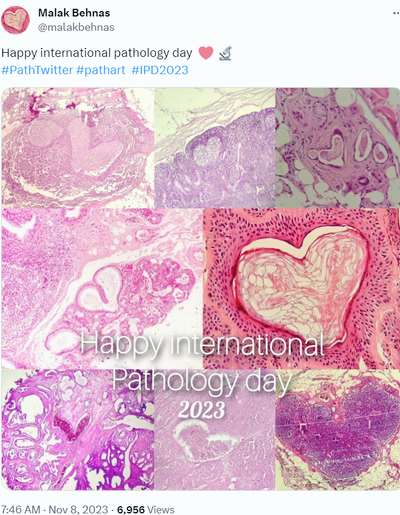
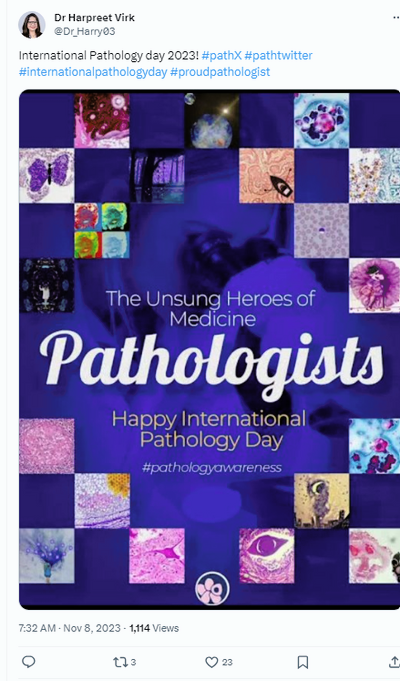
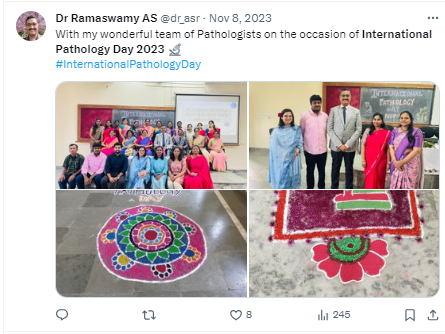
Social media and activities for IPD from around the world
Appreciations
Thanks to everyone who joined us for the event, our esteemed speakers and to our sponsors, the British Society for Haematology and The Pathologist. International Pathology Day is made possible by months and months of planning and dedication by the International Team and sponsors.
International Pathology Day 2024
Next year, IPD will explore antimicrobial resistance and will take place on Wednesday 6 November. Please save the date. More details about the event will be released in late summer 2024.