
Members only

Progress in the deployment and utilisation of digital pathology systems for histopathological diagnosis has accelerated over the last 5 years, with many clinical pathology departments keen to capitalise on the potential to improve administrative and diagnostic efficiency, patient safety and professional collaboration. More widespread use of whole-slide imaging techniques for primary diagnosis has led to increased interest in computational pathology and the use of artificial intelligence (AI) to support clinicians in making an accurate diagnosis. The National Pathology Imaging Co-operative (NPIC), based in Leeds, is an innovative partnership between the NHS, industry and academia with 3 main aims:
From the outset, the NPIC leadership team was adamant that the work must genuinely include and involve those people who are likely to benefit from improved cellular pathology services, represented by patients with lived or other relevant experience. The principal aims were to understand current public views, adopt a co-production and collaboration approach for the creation of public-facing communications, and create opportunities for public debate and discussion. Many of these aims were realised by establishing a patient and public advisory group (PPAG) to work through the issues and to collaborate with others who bring relevant experiences and insight.
Involvement of and engagement with patients and representatives of the public can help produce clinical services and research that are more relevant to the real world. It helps to strengthen community links with healthcare providers and engender public trust. There is also an important role in supporting governance and accountability, particularly where public money is being invested. Many of our PPAG members also see patient and public involvement and engagement (PPIE) work as an opportunity to influence policymakers and funders.
For pathologists, PPIE work offers a valuable opportunity to connect with patients, gain new insights based on ‘lived experiences’, be reminded of patient pathways beyond the walls of the pathology department, and develop and refine communication skills for a new audience.
Involvement of the public in discussions around the adoption of AI and similar technologies is of particular relevance and value, given the potential to impact health outcomes and the perceived threat of AI, as evidenced in popular media (apocalyptic depictions of rogue AI) and recent news stories highlighting failures of similar technologies.
The NPIC PPAG convenes for regular online meetings with the NPIC leadership team, covering topics including use of patient pathology image data, data security, ethical implications of the use of AI, practical issues of public interest and consideration of new research projects and partnerships. The principal influence, impact and benefit of the advisory group is that the entire leadership team for the NPIC programme has regular, and occasionally challenging, conversations with patients and members of the public on a wide and comprehensive range of topics, which form part of the deployment of this service into routine NHS care.
There have been important conversations and sharing of views about issues such as commercial interests, data ownership and data access and how these are being managed and governed in a way that is more transparent and acceptable to a challenging public audience. One of the key messages our group conveyed was their attitude to pathology image data sharing. There was an expectation that pathology images should be shared across institutions and trusts, including beyond their region of origin, so that patients could benefit from the best professional advice available. Similarly, the group supported the use of their pathology images in the development and training of AI applications, provided their priorities of data security and confidentiality were honoured.
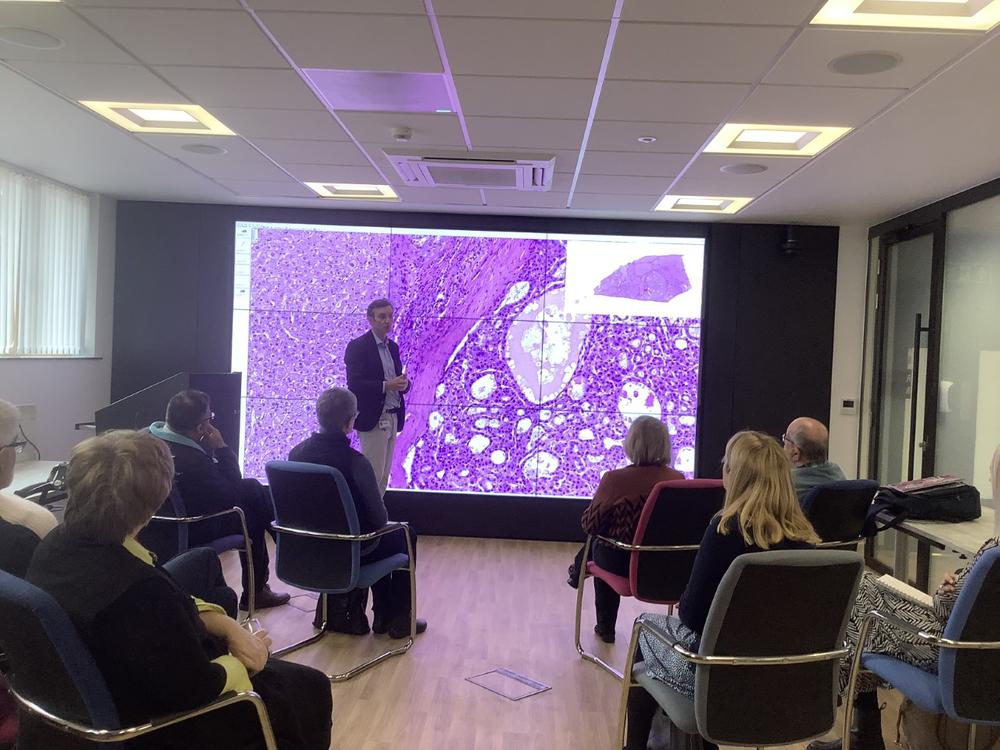
The key messages our group convey surround priorities from the patient and public perspective – foremost amongst these is the importance of getting an accurate diagnosis as promptly as possible, so that patients and their families can either breathe a sigh of relief or start to make informed decisions about the pathway forward. Our group were interested in how digital pathology might make pathology pathways more efficient, particularly referrals for multidisciplinary team review or secondary/expert opinion. Digital slides are a flexible, easily transferable and resilient format for healthcare professionals to access and share histology.
Alongside this, the other key benefit the group identified was one of enhanced equity of access to specialist and expert opinion, particularly for rare tumours or conditions, and particularly for patients living in communities that are more poorly served by diagnostic services. The public is used to digitisation of radiology services and patient records, and there was some surprise that pathology imaging was not similarly modernised already.
AI is a thorny topic. Again, the group could see great benefits to patients in terms of the potential to provide a faster diagnosis and more accurate and repeatable cancer grading and staging. They also expressed concerns around the transparency and explanation of decisions made through AI. There were also worries that the relationship between doctor and patient (already a more distant relationship for the pathologist compared with other specialties) might be further eroded. The concept of fairness and bias was interesting to explore, with AI seen as a ‘leveller’, enabling wider access to diagnostic services, but also a potential source of bias if algorithms are designed without appreciating the full and complete diversity of the populations they are expected to be applied to.As a result of our discussions, we have come up with some key messages from our patient and public representatives, directed at pathologists:
The authors gratefully acknowledge and thank the members of the NPIC PPAG for their invaluable contributions in the conception, planning, writing and review of this article.
National Pathology Imaging Co-operative, NPIC (Project no. 104687) is supported by a £50 million investment from the Data to Early Diagnosis and Precision Medicine strand of the government’s Industrial Strategy Challenge Fund, managed and delivered by UK Research and Innovation (UKRI).