
Occult hepatitis B and immunosuppression: closing the gap between testing and long-term monitoring
European Association for the Study of the Liver (EASL) 2025 guidance recommends routine HBsAg and HBcAb screening in all patients prior to immunosuppressive therapy, as well as HBV DNA testing in HBcAb positive patients. This article explores the risks of occult hepatitis B reactivation during immunosuppressive therapy, presenting local audit findings that reveal gaps in long-term monitoring and highlighting the implications and learning points for pathology practice.
Why does occult hepatitis B matter?
Occult hepatitis B infection, defined by a positive hepatitis B core-antibody (HBcAb) in the absence of detectable hepatitis B surface-antigen (HBsAg), may reactivate in patients receiving immunosuppressive, biologic or oncological therapies. Reactivation can lead to acute hepatitis, liver failure and interruption of essential treatment, and has been associated with mortality rates approaching 20% in severe cases.1
A large meta-analysis2 of occult HBV reported a prevalence in blood donors in low-endemicity countries of 0.06%, (95% CI 0.00–0.26), rising to 0.98% (0.44–1.72) in high-endemicity settings. In contrast, prevalence among high-risk groups – including people living with HIV, patients receiving dialysis and those with haematological malignancies – is substantially higher, reaching approximately 5–12% irrespective of endemicity.3
Pre-treatment hepatitis B testing is now well embedded within many biologic and chemotherapy pathways. However, identification of HBcAb positivity represents only the starting point. Safe management requires appropriate risk stratification, baseline HBV DNA testing, use of antiviral prophylaxis for high-risk therapies and structured long-term monitoring. This downstream phase is more complex, often spans multiple specialties and is, therefore, vulnerable to variation in practice.
From testing to monitoring: what happens after anti-HBc positivity?
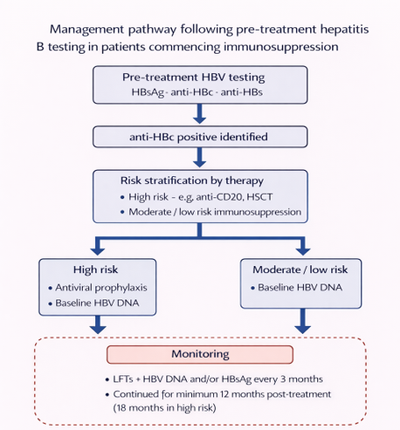
European Association for the Study of the Liver (EASL) 2025 guidance4 recommends routine HBsAg and HBcAb screening in all patients prior to immunosuppressive therapy, as well as HBV DNA testing in HBcAb positive patients. Antiviral prophylaxis is reserved for those receiving high-risk therapies such as anti-CD20 agents (Figure 1); whereas for patients receiving moderate- or low-risk therapies, regular monitoring of liver function tests and hepatitis B markers during treatment and for at least 12 months following treatment completion is advised.
From 11/06/2024 to 11/06/2025, 3,901 patients at the Royal Devon University Healthcare NHS Trust underwent pre-treatment hepatitis B testing prior to initiation of biologic or immunosuppressive therapy. Testing included HBsAg and HBcAb using the Elecsys HBsAg II and Elecsys Anti-HBc II assays on the Roche Cobas e601 immunoassay analyser.
1 patient was HBsAg positive and 33 were anti-HBc positive, consistent with occult hepatitis B. We undertook a local audit to assess how effectively EASL guidance was implemented following identification of anti-HBc positivity prior to treatment initiation. This was done by review of the laboratory information management system for laboratory testing, and the electronic patient record for clinical discussions that took place.
| Standard assessed | Compliance (n/N) | Percentage (%) |
|---|---|---|
| Complete hepatitis B serology prior to treatment | 33/34 | 97.1 |
| Baseline HBV DNA testing | 28/34 | 82.4 |
| Appropriate management of detectable HBV DNA | 2/2 | 100 |
| Antiviral prophylaxis for high-risk therapy | 2/2 | 100 |
| 3-monthly HBV DNA monitoring during treatment (mod/low risk) | 15/31 | 48.4 |
| ≥ 12-month post-treatment monitoring | 2/5 | 40 |
| Documentation of reactivation risk discussion | 27/34 | 79.4 |
| Regular liver function monitoring | 29/34 | 85.3 |
Results
Baseline HBV DNA testing was performed in 28/34 (82%) patients with occult hepatitis B; however, regular monitoring during and after treatment was frequently incomplete (Table 1). Patients receiving high-risk therapies (n=2) were managed appropriately, supported by established multidisciplinary pathways involving hepatology and haematology. In contrast, care for those on moderate-risk immunosuppression was less consistent, with gaps in both virological assessment and ongoing follow-up.
Overall compliance with surveillance, during and after treatment, fell below the expected standard. Of the 34 treated patients, 17 remained on active therapy at the time of audit and 2 died during treatment.
Among the 15 patients who had completed therapy, 10 were within 12 months of treatment cessation and had at least 1 post-treatment review, although only 3 had been monitored consistently at 3-month intervals. 5 patients had completed treatment more than 12 months previously and were therefore eligible for assessment against the ≥ 12-month-post-treatment monitoring standard. Of these, only 2 (40%) had documented virological monitoring for the full 12-month period, while 3 had no recorded evidence of appropriate post-treatment surveillance.
The HBsAg-positive patient had known chronic hepatitis B infection and was already established on antiviral therapy prior to commencing immunosuppression. 2 patients had detectable HBV DNA: 1 was identified before treatment and received antiviral therapy with appropriate monitoring, whereas the other experienced reactivation from occult to active infection. In this case, immunosuppression was reduced, but antiviral therapy was not initiated.
Finally, 1 patient with positive hepatitis B core antibodies had no documented reference to hepatitis B in the clinical record and no evidence of virological monitoring. Taken together, these findings suggest that the greater vulnerability lies within the larger cohort receiving moderate-risk immunosuppression, where responsibility for ongoing monitoring may be less clearly defined.
The role of electronic patient records
Pre-treatment testing is typically protocol-driven, whereas downstream management relies on individual clinicians to interpret results, arrange monitoring and ensure long-term surveillance.
This highlights the potential value of electronic patient record (EPR) systems in supporting continuity of care. Automated prompts linked to HBcAb positivity, reminders for 3-monthly monitoring and improved visibility of hepatitis B status at the point of prescribing could help bridge the gap between laboratory testing and clinical action. System-level interventions may therefore be more effective than education alone.
Implications for pathology and microbiology services
For pathology and microbiology services, occult hepatitis B represents an opportunity to move beyond result reporting towards supporting long-term patient safety. Laboratory identification of HBcAb positivity is a critical point that may benefit from enhanced interpretive comments, reflex testing protocols or electronic alerts.
As immunosuppressive therapies are increasingly prescribed outside traditional oncology and transplant settings, laboratories are well placed to support clinicians in recognising reactivation risk and appropriate follow-up. Strengthening the interface between laboratory systems, EPRs and prescribing workflows may reduce reliance on individual clinicians and help standardise care across specialties.
Learning points for practice
- HBcAb positivity identified on pre-treatment testing requires active management.
- Monitoring failures are most common in patients receiving moderate-risk immunosuppression.
- High-risk pathways work well where ownership is clear.
- EPR-based solutions may improve longitudinal monitoring and patient safety.
Conclusion
Occult hepatitis B represents a hidden patient safety risk in the context of immunosuppression. While pre-treatment hepatitis B testing pathways are now robust, downstream management remains vulnerable to variation. Embedding monitoring requirements within electronic systems and clarifying ownership across specialties may help ensure that identification of HBcAb positivity leads to sustained, guideline-consistent care rather than a missed opportunity for prevention.
References available on our website.