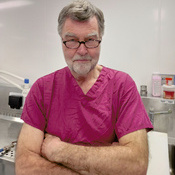
Appreciation: Professor Christopher Fletcher
Chris was a kind, thoughtful and generous friend for over 40 years. Both of us are deeply indebted to him.
He was a world-renowned surgical pathologist with great expertise in tumour pathology in general and soft tissue tumours in particular. Although he was initially drawn towards dermatopathology, he soon realised his real passion lay in soft tissue tumour pathology.
His career in the latter began when he was a trainee working on his Doctor of Medicine thesis. Utilising retrospective electron microscopy and immunohistochemistry of archival cases of so-called malignant fibrous histiocytoma, he demonstrated that the overwhelming majority of such tumours could be re-classified into more specific categories, including spindle cell squamous carcinoma, leiomyosarcoma and rhabdomyosarcoma among others. This was truly groundbreaking and paved the way for the better understanding and classification of soft tissue sarcomas.
Immediately after completing his training in pathology, he became a consultant at St Thomas’ Hospital in London and founded the Soft Tissue Tumour Unit in the early 1990s. On his own, with a single orthopaedic surgeon and a fellow, he managed to establish a world-class treatment and research centre that started attracting not only many consultation cases from the United Kingdom and abroad, but also pathologists from all over the world to train under his guidance and expertise. The unit flourished and grew with research grants that allowed him to cement his meteoric career.
During this time, he was granted a personal chair, becoming a professor. He was soon offered a post at the Brigham and Women’s Hospital, Harvard University in Boston, USA, where he established his ever-growing professional career until he took early retirement in 2022 to enjoy more time with his family.
He was not only a gifted pathologist and researcher but also a captivating orator. He was an amazingly witty, entertaining teacher and communicator, whose lectures around the world were always a sold-out phenomenon!
Chris’s career was quite remarkable, as evidenced by his breathtaking curriculum vitae listing approximately 600 original articles and over 150 review articles, chapters and books. He received innumerable distinguished honours, including the United States and Canadian Academy of Pathology (USCAP) Young Investigator Award in 1997. He served as president of many international societies, including USCAP, and was chairman of the WHO working group for the classification of bone and soft tissue tumours. His textbook, Diagnostic Histopathology of Tumours, is in its 5th edition and is essential reading material for all tumour pathologists.
The side of Chris that only the privileged experienced was the care and attention that he showed to the residents and fellows that came under his tutelage. His sign-out sessions on over 5,000 soft tissue tumour consultations at Brigham and Women's Hospital in Boston were a delight for all. He treated even the most junior pathologist with kindness and courtesy.
Chris was a remarkable man who is sorely missed, although his legacy will live on.
Chris is survived by his partner Nina and his daughters Amy, Alexandra and Fenella.
Eduardo Calonje
Phillip McKee
I first encountered Chris Fletcher in early 1982, having returned from working 2 years in Nairobi and assuming a 1-year consultant locum position at the Department of Histopathology at St Thomas’ Hospital, London. He was a young trainee and already stood out in a department not short of serious expertise under the leadership of Professor John Tighe.
My recollection is that he first took an interest in soft tissue pathology from working with Professor Michael Hutt in the Wellcome Tropical Pathology Unit (WTPU) within the department (headed by Hutt and Dennis Burkitt). The main pathological input to the WTPU was the weekly parcel containing all the biopsy material from hospitalised patients in Malawi, sent to UK for diagnosis (results returned by airmail), there being no path lab there at the time. A lot of soft tissue tumours, including Kaposi sarcoma (then a rarity in UK), were presented. And from that start he linked up with the orthopaedic and soft tissue surgeons in St Thomas’, and rapidly became their pathological point of reference.
By 1984, he had already authored papers on retroperitoneal fibrosis1 and inflammatory fibrous histiocytoma of the penis,2 as well as contributing to papers on tissue eosinophilia associated with skin, bladder and oral carcinomas.
He rapidly became a significant speaker on soft tissue pathology in the UK and gained the reputation of being the most highly qualified pathology junior, with the best publication CV, in the country. A personal chair in soft tissue pathology at St Thomas’ followed. In 1984, he demonstrated his attention to histological detail with a meticulous analysis of skin sarcomas.3 By the late 1980s and early 1990s, he was at the forefront of combining histopathology with genetic analysis of soft tissue tumours.4,5 This culminated in the major publication correlating lipomatous tumour morphology with cytogenetic abnormalities,6 where he was the lead author.
A major take-home message from the talks Chris gave concerned advising clinicians to think carefully about what to do for a tumour patient and not automatically go for maximal excisions and inevitable surgical morbidity. He was a true informed patient advocate.
References available on the website.
Professor Sebastian Lucas
Authors
Eduardo Calonje
Phillip McKee